We aim to reduce and responsibly manage waste across all aspects of our operations, from our office work to our products.
Our approach to waste management
GRI 306‑1, GRI 306‑2
Waste management at Kaspersky combines waste reduction, separate collection of waste, and responsible disposal.
A significant percentage of the Company's waste is associated with day‑to‑day office activities and the production of physical products. These are the areas where we focus most of our efforts to reduce our environmental burden.
Types of waste and how they are handled
The Company's offices generate mainly household and office waste, as well as certain types of hazardous waste, such as batteries and electronic devices. We have implemented a separate collection system at our Moscow office: we set up containers for paper, plastic, glass, metal, and mixed waste, and in the printer rooms, we have separate containers for waste paper, plastic caps, batteries, rechargeable batteries, and e‑cigarettes.
We entrust the collection, transportation, and transfer of waste for recycling or disposal to specialized companies. Additionally, all counterparties are checked for compliance with legal requirements. Waste of hazard classes I and III is subject to partial neutralization before being sent for disposal or burial.
GRI 306‑3, 306‑4, 306‑5
Waste generationThis includes waste from the Moscow office, including the data center, as well as waste from business operations., tons
Indicators
2023
2024
2025
Total waste generation at the Company's facilities, including:
225.6
353.7
410.8
Class I (extremely hazardous, non‑degradable waste: pesticides, asbestos, devices containing mercury)
0.1
0.3
0.3
Class II (highly hazardous waste that decomposes in more than 10 years: insecticides, fungicides, lead, arsenic, batteries, pyrotechnics)
0
0
0
Class III (moderately hazardous waste that decomposes in three to ten years: herbicides, paints and varnishes, detergents, shampoos, deodorants, mobile phones)
0.7
0.4
0.7
Class IV (low‑hazard waste that decomposes within three years: nitrogen fertilizers, fiberboard, chipboard, polyethylene film, mirrors, rubber gloves and shoes, disposable tableware, household appliances)
219.4
353.0
409.9
Class V (practically harmless waste that decomposes within three years: food products, natural fabrics and products made from them, paper and cardboard products)
research and select suppliers that offer products in recyclable and environmentally friendly packaging
refuse to use superfluous and functionally unjustified items in our operations
use reusable tableware and high‑quality materials with a long service life
make our souvenir and advertising products more environmentally friendly by selecting sustainable materials and solutions
In particular, we consistently reduce the use of plastic in the production of souvenir products. Instead of plastic bags, we purchase bags made of durable materials as well as reusable canvas bags.
In 2026–2027, the Company plans to implement programs to improve employee environmental awareness and revise internal regulations to reduce the consumption of paper and disposable materials. We will also explore the possibility of using equipment with a longer service life and upgrading existing equipment to reduce the volume of discarded equipment.
We optimize packaging
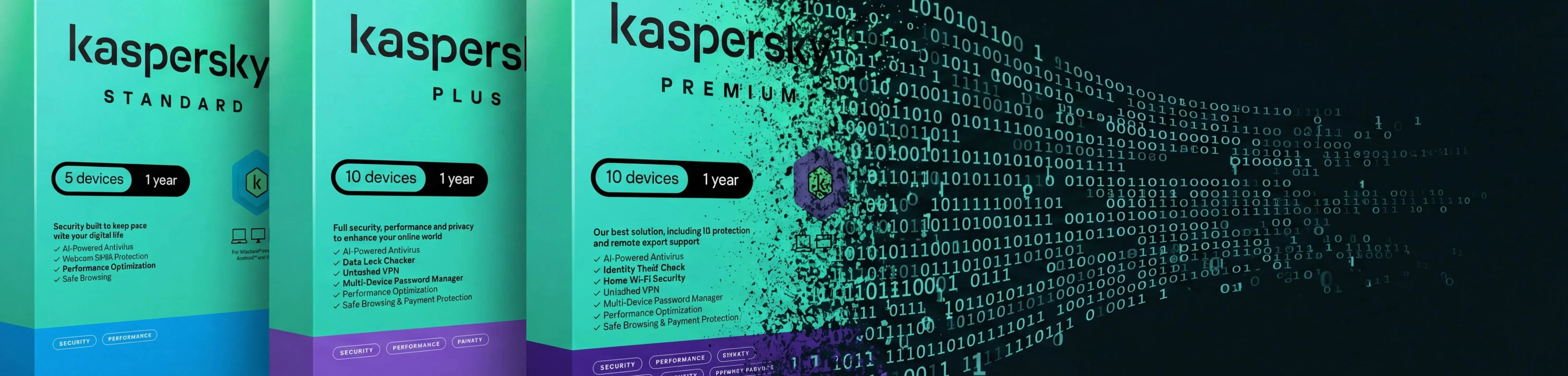
A significant portion of waste in the world is generated by product packaging. To decrease the volume of this waste, we consistently reduce our production of physical products, reducing box thickness and pallet space. We provide information on packaging to facilitate recycling, reduce waste, and promote digital distribution. In 2025, the Company's share of boxed products in sales of solutions for home users remained at 8.8%.
We cannot yet completely stop releasing products on physical media: some customers still prefer CDs or DVDs, mainly out of habit. In some regions, including African countries, this preference is due to the lack of stable internet access. For these products, we use compact packaging with the minimal plastic content.
Kaspersky products on physical media formats
Boxes, leaflets and envelopes
cardboard boxes or thin envelopes containing a flyer with a product activation code and a CD with the product
DVD cases
plastic boxes that do not contain a disc; instead, they contain a leaflet with a code (in French‑speaking African countries, the box also includes a disc)
Plastic cards
an activation code is hidden under a protective coating that is scratched off by the user for activation
POSA POR
A display card made of thin cardboard; the activation code is not located on the card but is printed on the receipt upon purchase.
POSAPoint‑of‑Sales Activation — A product that is activated at the point of sale. cards
a cost‑effective cardboard medium with a code (visible or hidden)
We are increasing the share of digital sales
Overall, the share of digital licenses and digital formats trended upward in 2022–2025, at different rates in different regions. We are actively transitioning our existing clientele to digital licenses through various mechanisms. In Russia, Latin America and Northern Europe, 85–90% of licenses are already digital.
36% of revenue from sales of home solutions comes from renewals, i.e. one year after purchasing a new license, users return to our website to purchase another one. Between 2024 and 2025, 6% of home licenses became digital as customers made their purchase online one year after their initial purchase in a retail store.
We encourage our partners to transition to purchasing licenses online, and distributors to distribute licenses through their own websites, which also simplifies access to foreign markets.
We are introducing more environmentally friendly packaging
In 2024–2025, the Company overhauled its retail packaging to make it more environmentally friendly. The updated formats are more cost‑effective. For example, the box is now 50% thinner and 20% lighter than the previous version, and the envelope is 80% more compact. We also completely eliminated the internal cardboard insert, which let us consume less cardboard and ink, reduce shipping volumes, and optimize storage at distributors.
52%
of sales were boxed solutions in 2025
48%
of sales were in digital formats in 2025
We use special labeling
In accordance with the Package and Packaging Waste Regulation (PPWR), Kaspersky places information on packaging to help consumers properly sort and dispose of used materials, and also complies with Extended Producer Responsibility (EPRExtended Producer Responsibility is an approach to environmental regulation under which manufacturers and importers are responsible for the environmental aspects of their products throughout their entire life cycle, including the collection, recycling, and disposal of packaging and waste after use.) requirements in all regions where it operates.
All Kaspersky packaging materials bear the required PAP/PP symbols. These are international labeling codes used to identify the composition of packaging and facilitate its sorting and recycling. PAP indicates paper and cardboard products, and PP means products made of polypropylene (plastic).
Our production is recorded in national EPR systems, and it is reported annually according to their rules. In France, we use the Triman logo, in Germany and Portugal the Green Dot, in Spain the colour‑coded Symbol for Recycling, and in the Italian market Disposal IT PRP (Preparazione per il Riutilizzo e il Riciclo) labeling with detailed disposal recommendations.
In addition, since 2025, products supplied to the Italian market will be additionally labelled with Forest Stewardship Council FSCThe Forest Stewardship Council (FSC) is an international non‑profit, non‑governmental organization that promotes responsible forest management worldwide. certification, which confirms the use of packaging materials from responsibly managed forests.
We conserve paper by developing digital processes
We reduce the use of printed materials and recycle old banners, posters, and photo panels. To save paper, Kaspersky has actively used an electronic document management (EDM) system with external contractors since the end of 2022.
In 2024, 75% more documents were signed via our electronic document management (EDM) system than the previous year, and another 20% more were signed that way in 2025.
More than 50% of our counterparties already work with us digitally, which covers over 40% of our accounting documents.
In the future, we plan to implement an internal electronic document management system for human resources.